What to see
Why do so many people photograph the Wukang Building?
The Wukang Building is an old apartment block on the wedge of land where two roads split in the former French Concession, designed in the 1920s by a well-known architect of the period, with its narrow end facing the junction so that the whole flat-iron outline reads in one frame from the opposite pavement. It is photographed so heavily because the corner composes well, the plane trees change with the season, the surrounding streets are full of old buildings, and its reputation has fed on itself online; the cost is a crowded pavement at peak times on a block where people still live. For the architecture and the streets it is worth a deliberate trip; for a single social-media photograph the experience is usually worse than the picture.
Last updated4 min read
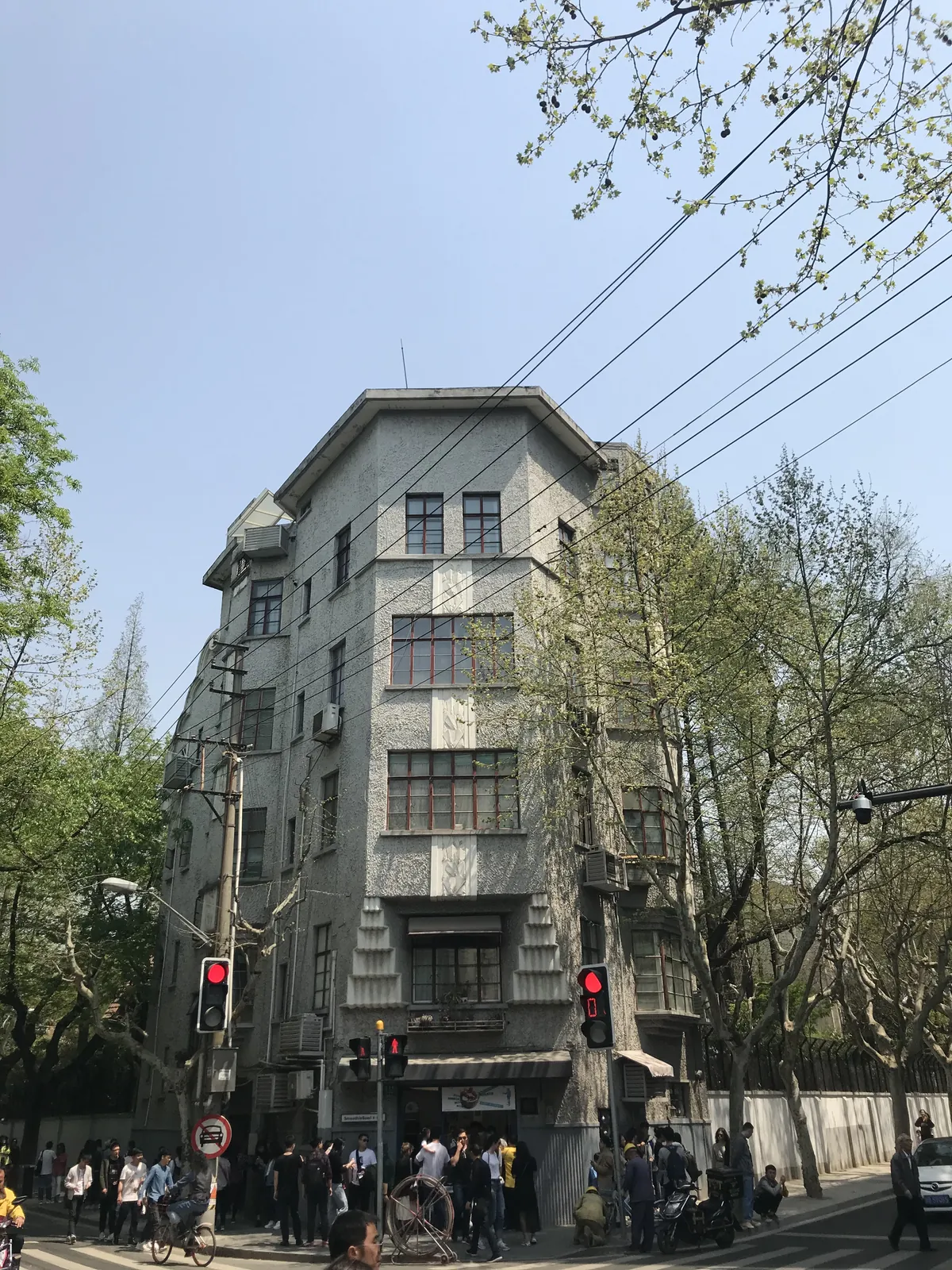
The Wukang Building is an old apartment block in the former French Concession, standing on the triangular plot where Wukang Road and a second street split apart. It repays photographing, and its photographs have circulated online for years; the result is one of the most photographed corners in Shanghai.
What it actually is
An apartment block of the 1920s, designed by a well-known architect of the period, with a wedge-shaped plan following the angle between the two roads and its narrow end towards the junction: an apartment type rare in this part of Shanghai. It went up in the years when new lane housing and garden villas were built across the district, so it belongs to that wave of construction rather than standing apart from it. It is still residential — people live in it, and the ground floor is a row of ordinary street-level shops, in the plane-tree district of the former French Concession, in today’s Xuhui District. Treating it as a working apartment building rather than an attraction comes closer to the truth.
Why it photographs so well
First, the shape: the wedge forms a nearly complete point at the junction, with long elevations running away down both roads and horizontal floor lines stacked against the vertical corner, so one frame from the pavement diagonally opposite holds the whole building. Second, the scale: it is not tall yet fills a street corner, so you can take it in standing at the kerb, without retreating and with nothing blocking the view — rare in the middle of a city. Third, the plane trees: the street trees change with the season, so the same position yields different pictures through the year; in full leaf they hide part of the facade, in winter the outline is fully exposed. Fourth, the surroundings: the garden villas, lane housing and rows of trees along Wukang Road sit inside the same frame, so one visit yields a set of photographs rather than one.
What the fame costs
Old architecture, plane-tree streets, metro access, and a corner that seems made for a vertical phone frame made it a place photographed over and over online; once the pictures reached a certain volume the crowd became permanent. Weekdays are comparatively quiet; weekends and public holidays in daylight mean waiting for a position. The pavement in front is narrow and photographers concentrate on the same short stretch, so at peak times you queue or turn sideways to pass, and when numbers are high, traffic police or security staff manage the junction, with stopping or the direction of movement restricted at certain hours. For the people who live there it is the daily pressure of being photographed; the shops underneath are ordinary street businesses most visitors walk past.
If you want the photograph, and whether it is worth the trip
Stand on the pavement diagonally across the junction, where the full wedge fits the frame; do not stand in the roadway or block the entrance and shopfronts. Morning and late-afternoon side light gives the facade depth, midday is flat, and which position is quietest varies with the day’s roadworks, the trees and the crowd. This is somebody’s home: do not shout, play music or fly a drone, and do not pose below someone’s window; take the picture, move on and give the pavement back. For an empty frame, arriving early beats any technique. For anyone interested in architecture, streets or city photography it is worth a deliberate trip, combined with the surroundings — Wukang Road slowly into the Wuyuan Road, Anfu Road and Fuxing West Road area takes an hour or two. A general sightseer should treat it as one stop on a walk through the plane-tree district, not half a day; coming only for a social-media photograph usually disappoints against the picture. Avoid weekend afternoons, public holidays and the hour after sunset; a weekday morning is least trouble. If the crowd puts you off, move the emphasis to those surrounding streets, which offer the same plane trees, garden villas, lane housing and small shops with far fewer people and no jostling for a position.