Etiquette
Lu Xun Park and the memorial hall: how to spend half a day in Hongkou
Lu Xun Park in Hongkou, with the memorial hall and his tomb inside it, fills half a day: the park is a working city park, the hall is a memorial display. This covers who Lu Xun was, what is actually inside, how much of it works without Chinese, and how to fold in Duolun Road and Shanyin Road.
Last updated7 min read
Lu Xun Park is in Hongkou, on the west side of North Sichuan Road, with the memorial hall and his tomb inside it. Within a kilometre is one of the densest patches of Shanghai’s modern history: the streets left by the Japanese community, the meeting places of left-wing writers and the 1930s lane houses and apartment blocks survive, mostly as plaques.
Who Lu Xun was, and why a park and a museum carry his name
Lu Xun was the pen name of Zhou Shuren, born in Shaoxing in the late Qing; he studied medicine in Japan and gave it up for literature. A Madman’s Diary, The True Story of Ah Q, Kong Yiji and a large body of essays were written in the modern Chinese then just taking shape. He spent his last years in Hongkou and died in Shanghai in 1936, his coffin at the funeral covered with a banner reading Soul of the Nation.
His standing today comes half from the work, half from later confirmation: his essays were required reading in Chinese textbooks for decades, and he was made an officially recognised cultural symbol, with the memorial hall, the park’s name, the former residence and the statues across the country all belonging to that arrangement. Stating this is not judging it.
He was not a gentle man: he argued all his life, attacking old-style literati and criticising comrades inside the left-wing camp too. Memorial displays rarely put that side first; to meet the sharp Lu Xun you have to read him.
What the memorial hall actually contains, and how far it works without Chinese
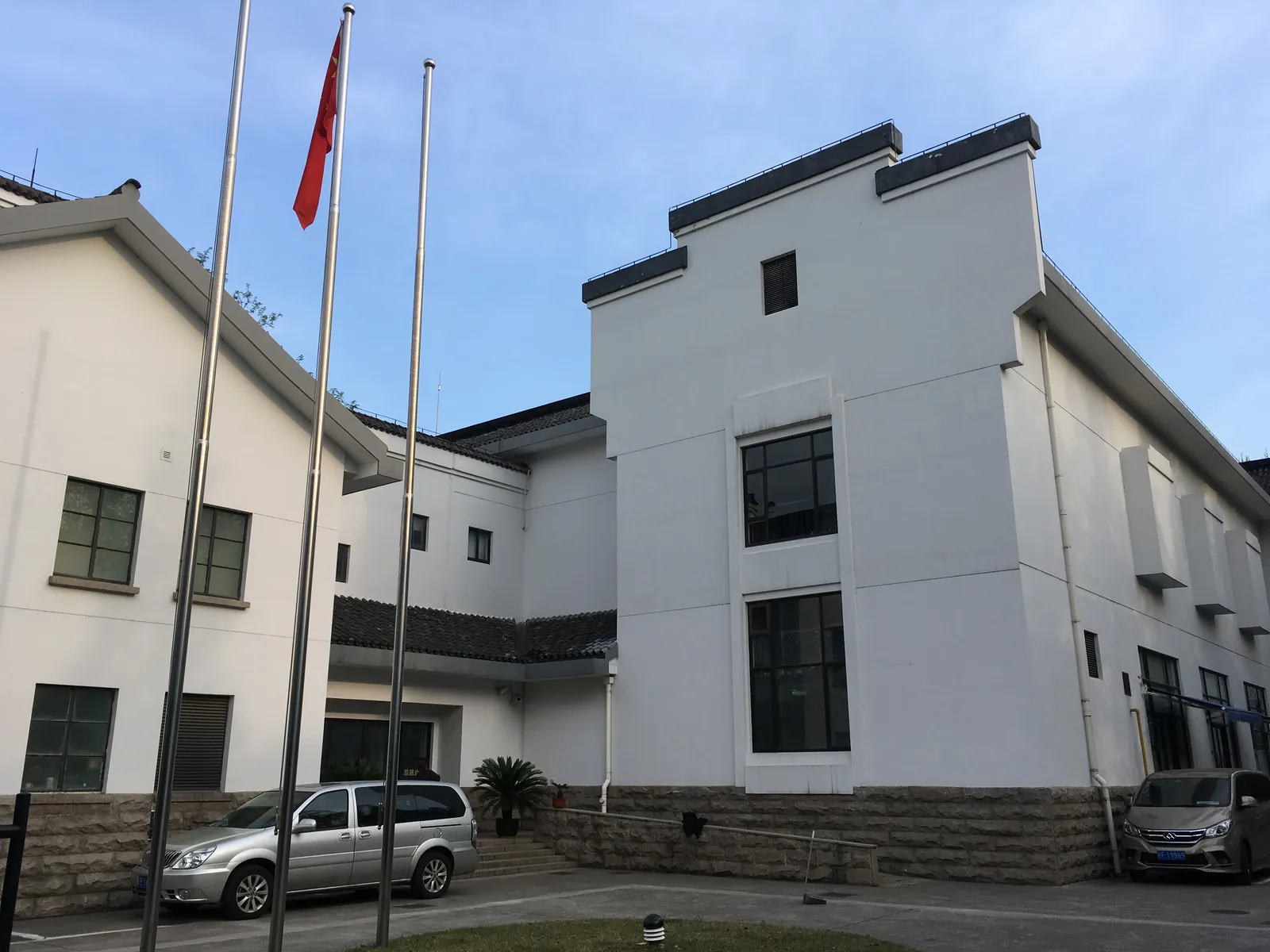
The hall stands inside the park facing North Sichuan Road: white walls, dark tiled roofs and stepped gables borrowed from the houses of his native Shaoxing, tying the name to Jiangnan; the name above the entrance is in the calligraphy of a former premier of the republic. It is not large: an hour or two if you read carefully.
The display runs chronologically: childhood in Shaoxing, study in Nanjing, medicine in Japan and the switch to literature, the New Culture Movement, the move south to Xiamen and Guangzhou, the last decade in Shanghai. Objects are mainly manuscripts, letters, first editions, photographs and personal effects, with a few reconstructed interiors; much of the hall covers what came after him, from the funeral and the coffin banner to the tomb’s move and the hall’s founding.
It is a memorial, not a critical biography: solemn in tone, settled in its conclusions, with little room to judge. Opening days, booking and closing times change, so check the day’s official information.
What a non-Chinese reader gets. The objects work; the text does not fully. Handwriting, first-edition covers, photographs and his desk things need no translation, and case labels usually give bilingual names and dates. The limits are concrete: the text is overwhelmingly Chinese and the English mostly caption-length, and the narrative assumes background knowledge, from the imperial examinations and study in Japan to May Fourth, the left-wing writers’ league and the war, so without it you see a man who kept getting into trouble for writing without seeing why it was serious. His work is also language: irony, the mix of classical and vernacular and the Shaoxing speech underneath lose a great deal in translation, and panel quotations arrive as meaning without force.
The practical answer is to read one of his short stories before you come; good translations exist in many languages. With that layer the cases mean something; without it, treat the hall as forty minutes of building and objects and give the rest of your time to the park and the streets.
The park itself: a park people still use
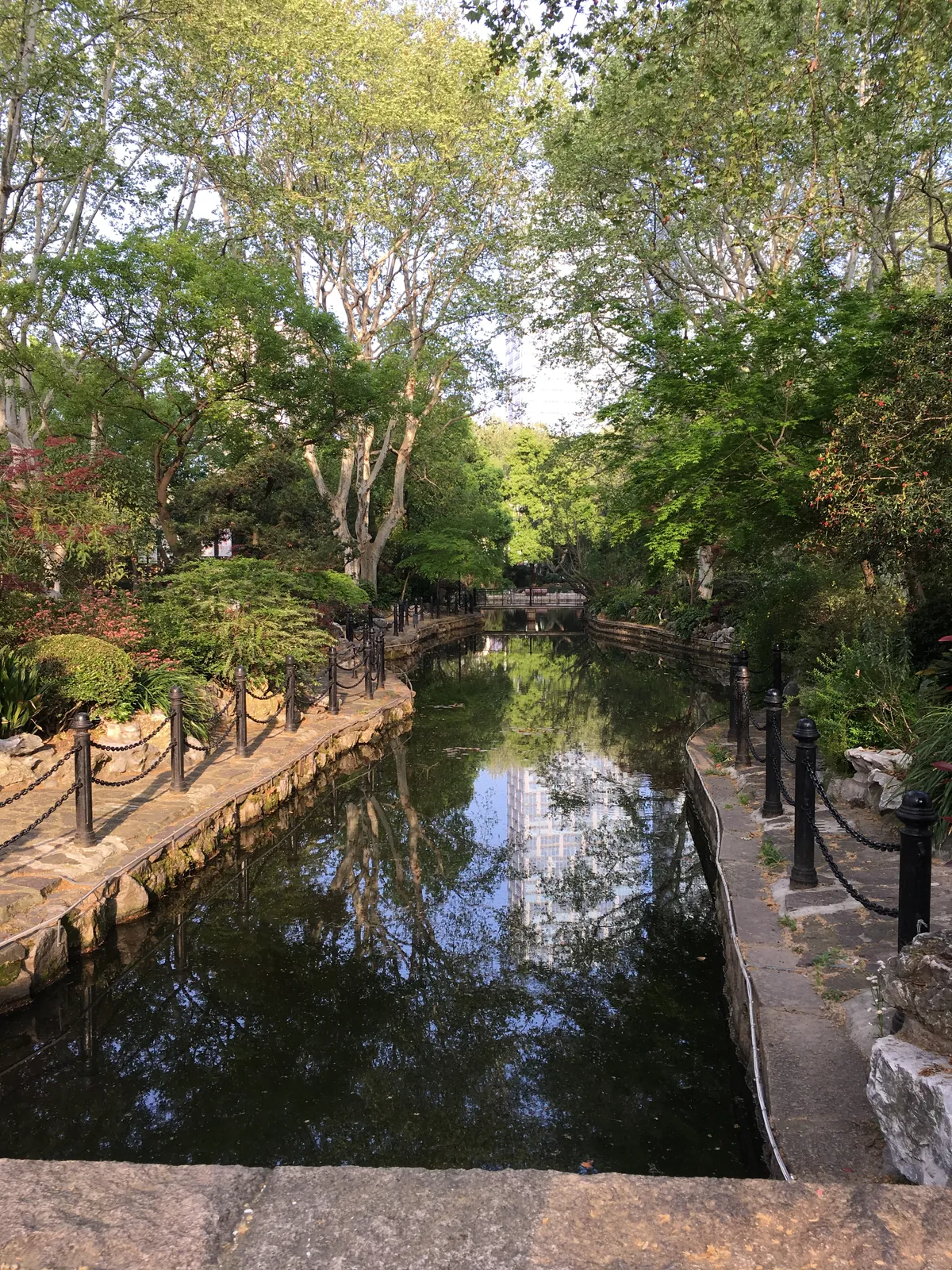
The park was originally Hongkou Park and took its present name later. It is a full city park, not a pocket garden: dense trees, a narrow water channel through it, lawns, a children’s playground, covered walkways, and railings and bridges at the water. A loop takes forty minutes to an hour, and there is no visitor route, so any gate will do.
The park belongs to the neighbourhood. From half past five to eight in the morning it is busiest: tai chi, fan dancing, choirs, instruments, badminton, diabolo, water calligraphy on the paving, chess and cards. What you see then is not a sight but an ordinary Shanghai day, and for many the most important social hour they have.
The tomb is inside the park: a granite platform with a seated bronze figure of Lu Xun in front and an inscription on the wall behind, written by Mao Zedong. The coffin was moved here from elsewhere in the 1950s. It takes ten minutes to look at, but it answers why the park carries the name. A plum garden pavilion nearby relates to a Korean independence activist who threw a bomb at a Japanese ceremony in Hongkou Park in the 1930s, which caused a sensation at the time.
Beyond the park: Hongkou’s streets, its old Japanese quarter and its literary map
First, a correction: Shanghai had no Japanese concession. Hongkou was part of the International Settlement, and from the late nineteenth century a large Japanese population settled here. By the 1920s and 1930s the Japanese shop signs, schools, temples and businesses along North Sichuan Road were dense enough to look like a Japanese city, one of the largest Japanese communities outside Japan. In the late 1930s the area came under Japanese military control; after the war the community was repatriated. No Japanese quarter survives, but the street pattern and lane houses do.
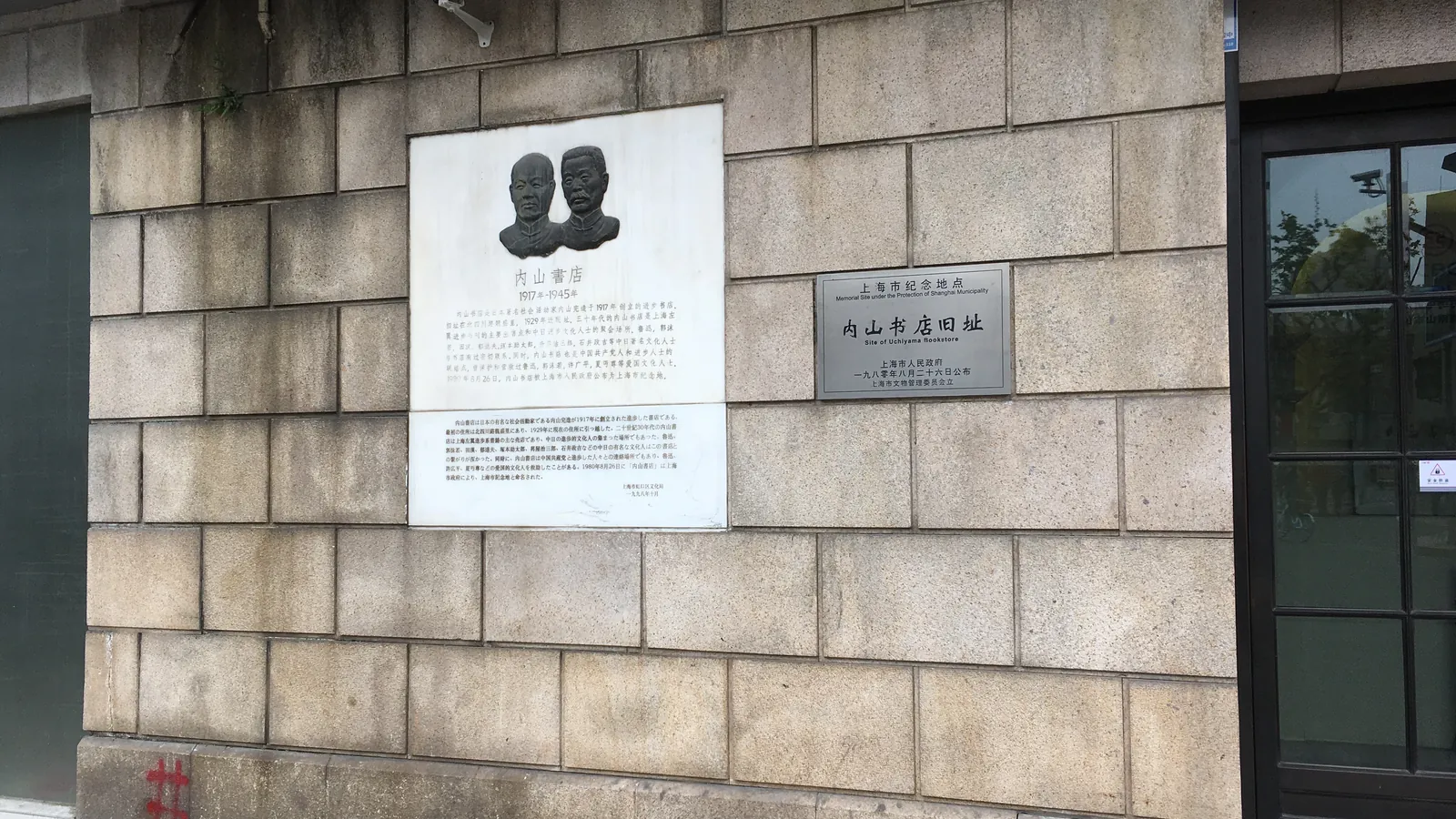
- The Uchiyama Bookstore site. On North Sichuan Road, where the plaque in the photograph above stands. Uchiyama Kanzo, a Japanese bookseller, ran his shop here; Lu Xun came often to buy books and meet people, and sheltered here when in danger. The shop is long gone and the plaque is what remains, the standard form Hongkou’s history takes: plaque there, building not.
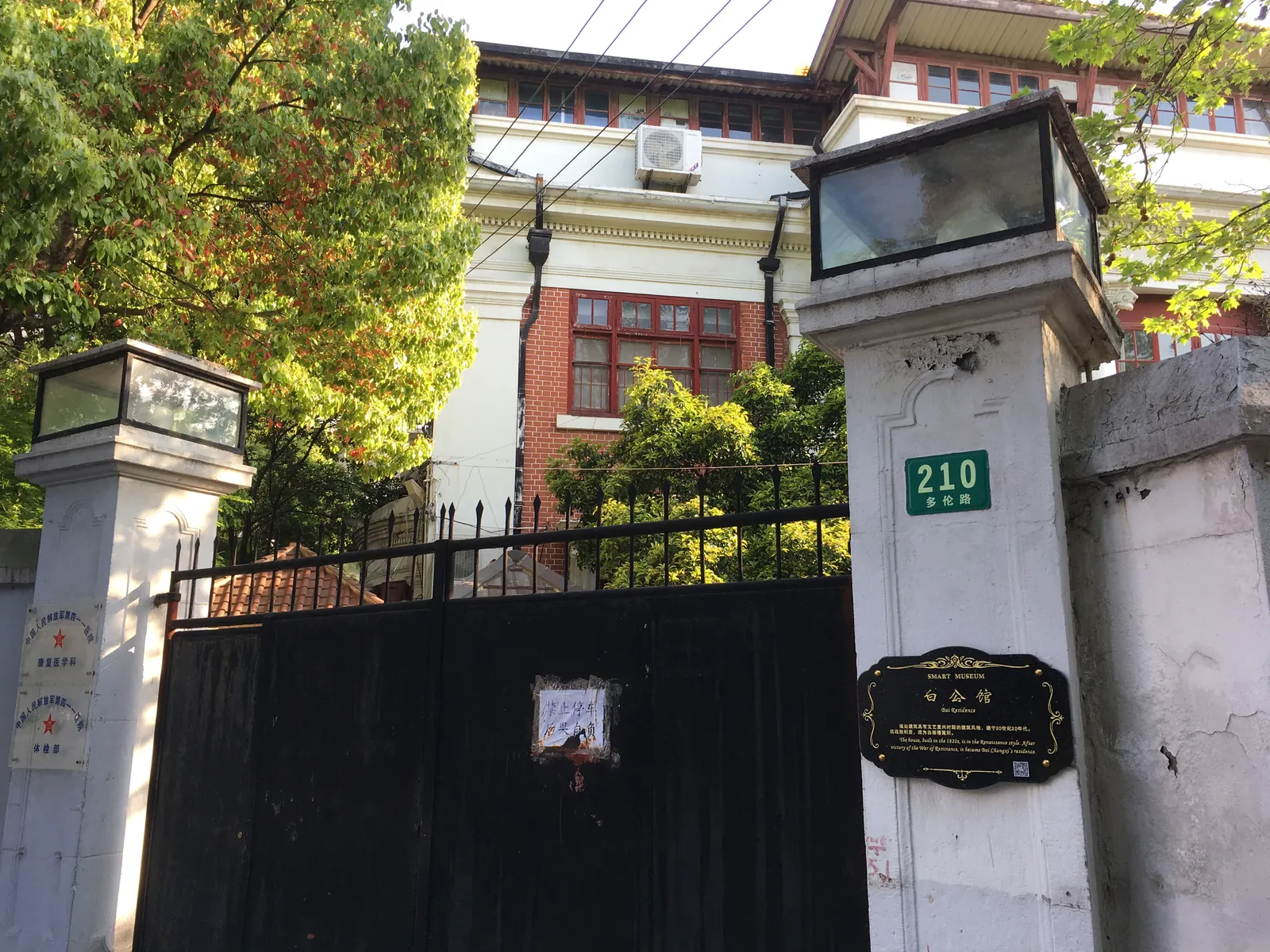
- Duolun Road. Ten minutes on foot: a short, bent street redeveloped in the 1990s. What is worth seeing is the site museum of the League of Left-Wing Writers, founded here in the 1930s with Lu Xun a central figure; five younger members were later arrested and executed, among them Rou Shi. Old villas line the street, most viewable only from outside.
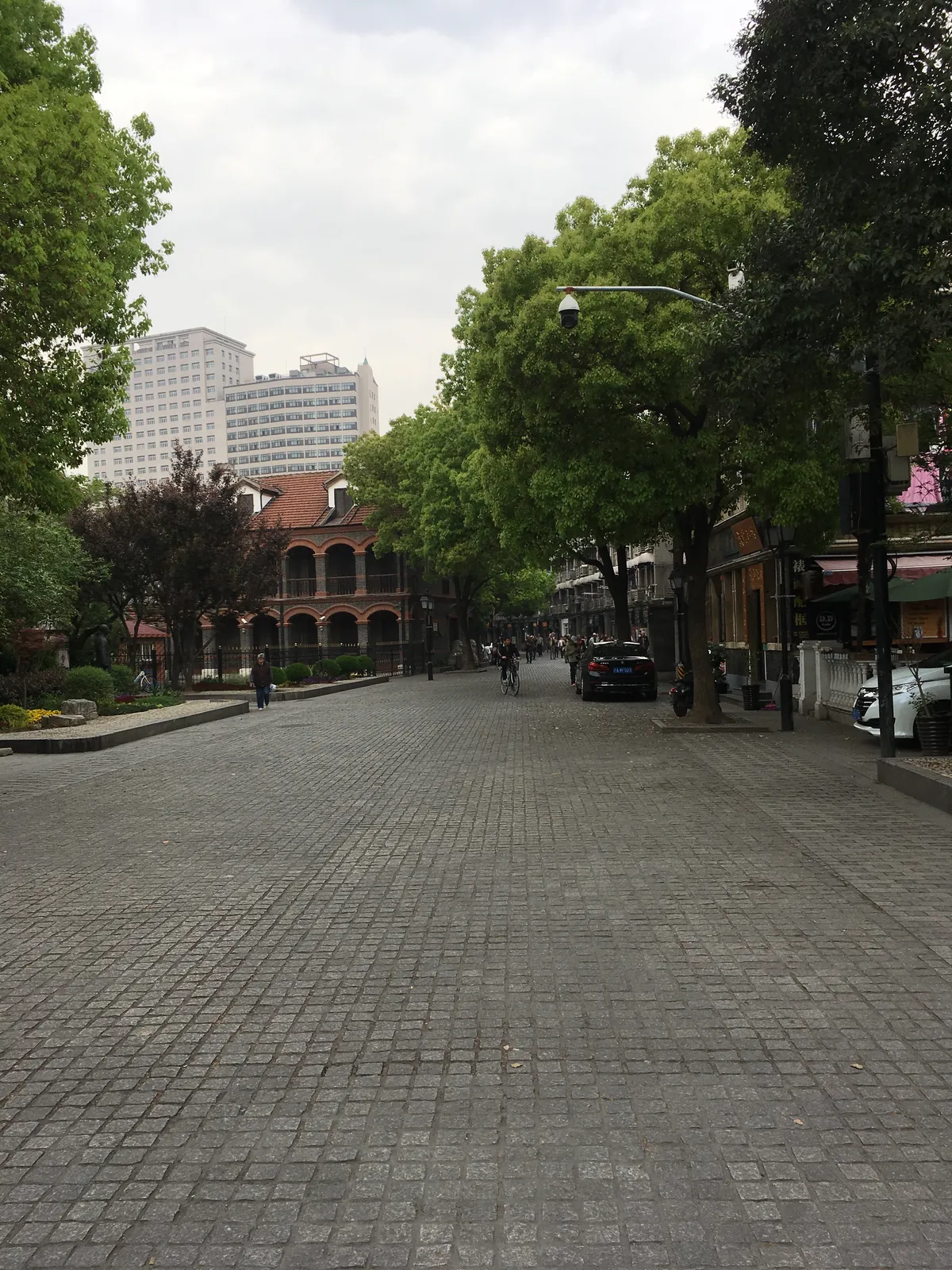
- Shanyin Road and Tian’ai Road. Plane trees, lane houses and old apartment blocks make this the most pleasant walking in the area. Lu Xun’s former residence is on Shanyin Road, where he lived in his last years; it is very small, so check on the day whether you can go in.
- A little further out. 1933 Laochangfang is a 1930s abattoir turned design and events complex, and Tilanqiao has a museum commemorating the Jewish refugees sheltered in Shanghai during the war. Each needs an hour or two and a ride.
How half a day works, and how to get there
No metro line numbers here: lines and station exits change. The park’s south side faces North Sichuan Road and its north side sits against a stadium, whose name the metro station beside it carries, a few minutes on foot following the signs. Which line and exit to use is a question for a map app on the day. A taxi needs only the park’s name, or the south gate.
- Morning, the best version. Reach the park before half past seven for the exercise groups; enter the hall between half past eight and nine, when it is emptiest; spend an hour to ninety minutes inside; see the tomb on the way out; walk ten minutes to Duolun Road and eat lunch around North Sichuan Road. Four to five hours in total.
- Afternoon. The hall first, then the park and the tomb, then Shanyin Road and Tian’ai Road, with dinner on North Sichuan Road. The hall closes well before the park, so do not leave it last.
- Rain or high summer. The hall plus Duolun Road, and only the waterside stretch of the park.
Whether you add 1933 Laochangfang or Tilanqiao depends on your remaining stamina; the hall’s opening days and the park’s seasonal hours are separate arrangements, so check each before you leave.
Who will find this worthwhile, and who should skip it
Worth it for anyone interested in modern Chinese literature or republican-era history; anyone who wants to see how Shanghai people use a park; anyone with half a day spare who would rather not spend it in the crowds at the Bund or Yu Garden.
Skip it if you have only two or three days and your list is headline sights, because this is not on it; if you do not read Chinese and have no interest in Lu Xun, leaving an ordinary city park and an hour of Chinese wall text; if you came for fine architecture or gardens; or if you dislike walking.
The best thing here may not be the memorial hall at all, but the people using the park in the morning.
place.gallery
Photographs